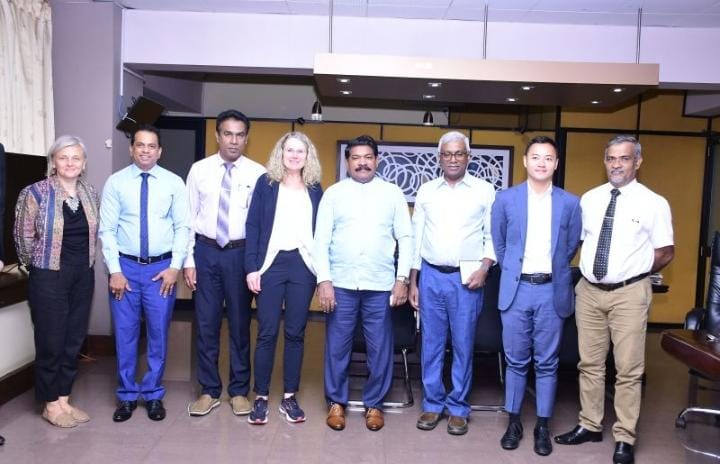
A World Bank team and experts from Wageningen University, Netherlands, held a key discussion with the Minister of Fisheries on the development of cold chain (frozen and deep-frozen fish products) in Sri Lankan fisheries sector.
Currently, most multi-day fishing boats in Sri Lanka below 60 feet use only ice. Due to the lack of internal refrigeration systems in most boats, a large amount of ice has to be carried. This increases the weight of the boats and increases fuel consumption. This also leads to rapid deterioration of the quality in fish.
It was reported that the operation of conventional cold room facilities is expensive due to the cost of electricity and unstable power supply, and that the cold room facility which is possessed with 800 metric ton capacity and 7.5 ton floor freezers of the Ceylon Fisheries Corporation (CFC) are currently in need of renovation and capacity enhancement.
The following were identified as the main issues facing by the fisheries sector:
- The current system, which relies solely on ice, reduces the lifespan and quality of fish harvest.
- Fuel consumption increases due to the weight of additional ice.
- There is no suitable cold room facility at major ports and central fish markets.
- Inadequate freezer system facilities for three-wheelers and lorries with small freezers.
- Lack of temporary storage facilities during monsoons causes huge losses to inland water fishermen
Short-term solutions proposed:
- Introduction of solar or other renewable energy-powered freezer systems for boats below 60 feet.
- Establishment of solar-powered cold storage and ice storage facilities at major fishing ports and Peliyagoda market.
- Upgrading of CFC cold storage facilities with thermal insulation, efficient compressors and solar energy connectivity
- Introduction of solar-powered refrigerated three-wheelers for inter-city distribution.
- Introduction of lorries with freezers which were equipped with solar charging facilities for medium-distance transportation.
- Promotion of the use of low-cost solar refrigerators and freezers for retail outlets.
The World Bank and experts agreed to discuss the implementation of pilot projects by selecting three ports or several reservoirs and to allocate a fund of US$ 35 million for this program.
Representatives of the World Bank, experts from Wageningen University in the Netherlands, the Secretary to the Ministry of Fisheries and senior officials participated in this discussion.